
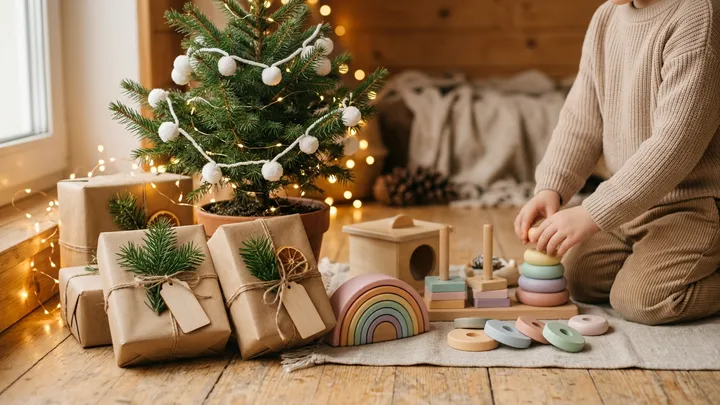
Montessori-aligned Christmas gifts focus on quality over quantity, real-world skills, and open-ended play. This guide organizes the best picks by age group and budget so you can find meaningful gifts without overspending or cluttering your home.
Christmas with young children is magical, overwhelming, and expensive — often all at once. If you are trying to keep your gift-giving aligned with Montessori principles, the holiday season can feel like swimming upstream against a current of plastic, batteries, and cartoon-branded everything.
But Montessori Christmas shopping does not have to mean deprivation or judgment. It means being intentional: choosing gifts that respect the child’s developing mind, serve a real purpose, and will still be interesting in March. This guide organizes the best Montessori-aligned gifts by age group and budget so you can shop with clarity and confidence.
Holiday Shopping, Montessori-Style: Principles That Guide Better Gift Choices
Before diving into specific products, let us establish the principles that separate a great Montessori gift from a toy that collects dust by January.
The Montessori Gift Criteria
A gift aligns with Montessori philosophy when it:
- Is open-ended — Can be used in multiple ways, growing with the child
- Develops a real skill — Motor, cognitive, creative, or practical life
- Is made from quality materials — Wood, fabric, metal, and silicone over cheap plastic
- Respects the child’s pace — Not too easy (boring), not too hard (frustrating)
- Does not do the playing for the child — No batteries, sounds, or lights that steal the child’s role
- Has longevity — Will be used for months or years, not minutes
The “Four Gift” Framework
Many Montessori families use a simple framework to limit holiday gift overwhelm:
| Category | Example | Purpose |
|---|---|---|
| Something they want | A balance bike | Honoring the child’s desires |
| Something they need | Quality rain boots | Practical life support |
| Something to wear | A cozy sweater | Care of self |
| Something to read | A beautiful picture book | Language and imagination |
This framework does not mean you can only give four gifts. It is a guardrail that prevents the “endless unwrapping” experience that often overwhelms young children and leads to none of the gifts being appreciated.
Reality check: Young children, especially those under 3, are often more interested in the boxes and wrapping paper than the gifts themselves. Reduce your gift count and increase your wrapping paper supply — seriously.
Gifts by Age Group: Finding the Right Match
Babies (0-12 Months)
Babies need sensory-rich, safe-to-mouth, high-contrast materials. Their gifts should support the developmental work they are already doing: grasping, mouthing, tracking, and beginning to sit and crawl.
Top picks for babies:
- Montessori Object Permanence Box — A box with a hole on top and a tray where the ball reappears. Teaches cause-and-effect and object permanence. See our full object permanence toys guide for details.
- High-Contrast Board Books — Black and white patterned books for newborns, graduating to bold colors by 6 months.
- Wooden Rattle Set — Natural wood rattles in different shapes provide varied grip challenges and pleasing sounds.
- Fabric Sensory Balls — Soft balls with different textures for grasping, rolling, and mouthing.
Lovevery Object Permanence Box
For comprehensive baby gift ideas, see our best Montessori toys for babies and best wooden toys for babies.
Toddlers (1-2 Years)
Toddlers are movers, climbers, dumpers, and explorers. Gifts should support their explosive physical development and emerging independence.
Top picks for toddlers:
- Pikler Climbing Triangle — The flagship Montessori gross motor toy. Folds for storage, lasts years, and children never tire of it.
- Wooden Stacking Toys — Rings, cups, or blocks that teach size sequencing and fine motor skills.
- Real Child-Sized Broom and Dustpan — Toddlers genuinely love sweeping. A real (not toy) broom their size is a practical life gift that gets daily use.
- Grimm’s Rainbow — The iconic arched rainbow blocks that become bridges, tunnels, houses, and sculptures.
Grimm’s Large 12-Piece Rainbow
Check our dedicated guides: Montessori gifts for 1-year-olds and Montessori gifts for 2-year-olds.
Preschoolers (3-5 Years)
Preschoolers are ready for more complex challenges: building, creating, problem-solving, and early academic skills delivered through hands-on materials.
Top picks for preschoolers:
- Magna-Tiles or Picasso Tiles — Magnetic building tiles that teach geometry, spatial reasoning, and creative construction.
- Real Cooking Set — Child-sized metal (not plastic) utensils, a cutting board, and a child-safe knife for real food preparation.
- Watercolor Paint Set — Quality watercolors with real brushes and thick paper. Skip the finger paints — preschoolers are ready for real art tools.
- Nature Explorer Kit — Magnifying glass, bug catcher, binoculars, and a nature journal.
Picasso Tiles 60-Piece Magnetic Building Set
Under $25: Affordable Montessori Gifts That Do Not Feel Cheap
Budget gifts do not have to be lesser gifts. Some of the most-used toys in Montessori homes cost less than a pizza dinner.
Books ($5-$20)
Books are the ultimate Montessori gift at any age. Prioritize:
- Board books for babies/toddlers with real photographs (not cartoons)
- Nonfiction for preschoolers about animals, space, the body, or how things work
- Montessori-specific books for parents — see our best Montessori books for parents guide
Recommended: The Montessori Toddler by Simone Davies — the single most useful Montessori parenting book available.
The Montessori Toddler by Simone Davies
Art Supplies ($8-$20)
- Beeswax crayons (Stockmar) — Rich colors, non-toxic, satisfying to hold
- Watercolor paint set — Even a basic Crayola set with real brushes works
- Large paper roll — Mount on a wall at child height for unlimited drawing
Stockmar Beeswax Crayons 16-Pack
Practical Life Tools ($10-$25)
- Child-sized apron for cooking and art
- Watering can for plant care
- Real whisk, wooden spoon, and mixing bowl set for kitchen participation
- Spray bottle and cloth for cleaning alongside parents
Nature Items ($5-$15)
- Magnifying glass — A real glass one, not a plastic toy
- Seed starting kit — Grow herbs or sunflowers together
- Rock and mineral collection — Labeled specimens for exploration
Small Manipulatives ($10-$25)
- Lacing beads — Large wooden beads for stringing
- Play dough tools — Rolling pin, cookie cutters, garlic press (real kitchen tools work best)
- Counting bears with sorting cups — Math and fine motor in one affordable package
For more ideas in this range, see our complete guide to Montessori toys under $20.
$25-$50: The Sweet Spot for Meaningful Gifts
This price range hits the sweet spot — quality materials, thoughtful design, and still reasonable for most budgets.
Balance Board (Wobble Board) — $30-$45. A curved wooden board for balancing, rocking, bridging, and imaginative play. One of the most versatile open-ended toys you can buy.
Melissa & Doug Wooden Tool Bench — $35-$45. Real wood construction with a vise, hammer, saw, screwdriver, and building pieces. Develops fine motor skills and introduces real-world tools.
Melissa & Doug Wooden Tool Bench
Tegu Magnetic Wooden Blocks (14-piece) — $30-$40. Beautifully crafted magnetic blocks from sustainably harvested Honduran hardwoods. The magnets are internal, so the blocks look and feel like natural wood but stick together in satisfying ways.
Tegu 14-Piece Magnetic Block Set
Quality Puzzles — $25-$40. Look for wooden puzzles with knobs (for toddlers), layer puzzles (for 2-3 year olds), or jigsaw puzzles in the 24-48 piece range (for preschoolers). Avoid puzzles with so many pieces that the child cannot complete them independently.
Play Kitchen Accessories — $25-$45. Rather than a full play kitchen, consider a set of realistic wooden or metal food prep items: a cutting board with velcro-closure fruits and vegetables, a tea set, or a baking set.
Gift-giving tip: When choosing between a cheaper toy and a slightly more expensive one in this range, look at the materials. A $35 wooden balance board will last through multiple children. A $20 plastic one will crack and be trash by spring.
Premium Picks ($50+): Heirloom-Quality Gifts Worth the Investment
Premium Montessori toys tend to be made from solid hardwood, designed by educators, and built to last decades. They are investments, not expenses.
Lovevery Play Kit Subscription — $80/quarter. Age-matched toy kits delivered every three months with a play guide explaining the developmental purpose of each item. Beautifully designed and one of the most popular Montessori-aligned gift subscriptions available. See our full Lovevery Play Kits review.
Piccalio Pikler Triangle — $150-$300. The gold standard for indoor climbing. Folds flat, solid hardwood, supports ages 6 months to 5+ years. An investment that gets daily use for years.
Piccalio Pikler Climbing Triangle
Grimm’s Large Rainbow — $70-$90. The iconic 12-piece arched rainbow in sustainably sourced lime wood with non-toxic dyes. Used as blocks, tunnels, bridges, fences, cradles, and art. The single most photographed Montessori toy on the internet for good reason — it is genuinely beautiful and endlessly versatile.
Strider Balance Bike — $90-$120. The most effective preparation for riding a pedal bike. Children as young as 18 months can start, and most Strider riders skip training wheels entirely.
Magna-Tiles 100-Piece Set — $100-$120. The larger set is worth the premium because it allows for more ambitious structures. These tiles get used daily from age 3 through early elementary and are compatible with all Magna-Tiles expansions.
Magna-Tiles 100-Piece Clear Colors Set
Stocking Stuffers: Small Montessori Gifts Under $15
Stockings are the perfect place for small, practical Montessori items.
| Item | Age | Price |
|---|---|---|
| Beeswax crayons (4-pack) | 1+ | $5-8 |
| Wooden spinning top | 2+ | $5-10 |
| Kaleidoscope | 3+ | $8-12 |
| Child-sized gardening gloves | 2+ | $6-10 |
| Wooden kazoo or harmonica | 3+ | $5-8 |
| Travel-sized playdough (homemade or Eco-Dough) | 18mo+ | $5-10 |
| Finger puppets (set of 5) | 12mo+ | $8-12 |
| Seed packets for spring planting | 3+ | $3-5 |
| Mini flashlight | 2+ | $5-8 |
| Washi tape set for crafts | 2+ | $5-10 |
| Measuring tape (real, retractable) | 3+ | $3-5 |
| Magnifying glass | 2+ | $5-10 |
Stocking filler hack: Include one useful consumable in each stocking — beeswax crayons, playdough, or craft supplies. These get used up and never add to toy clutter.
Experience Gifts: The Most Montessori Gift of All
Maria Montessori believed that children learn through direct experience with the real world. Experience gifts embody this philosophy more purely than any physical toy.
Memberships ($50-$150/year)
- Children’s museum membership — Unlimited visits to hands-on exhibits
- Zoo or aquarium membership — Repeated exposure builds real knowledge about animals
- Library card (free) — If your child does not have one yet, this is the best gift you can give
- Botanical garden membership — Nature study across seasons
Classes and Lessons ($50-$200)
- Swimming lessons — Life skill and gross motor development
- Music classes (Kindermusik, Music Together) — Rhythm, socialization, and sensory processing
- Gymnastics — For the child who needs to climb everything
- Art classes — Exposure to real media and techniques
- Cooking classes for kids — Many communities offer these for ages 3+
Experiences ($20-$100)
- A day at the farm — Picking fruit, meeting animals, riding a tractor
- Camping trip — Even a backyard campout counts
- Train ride — Many heritage railways offer short scenic rides
- A nature hike to a new trail — Pack lunch and a magnifying glass
- A special day with a grandparent — One-on-one time is irreplaceable
How to “Wrap” an Experience Gift
Experience gifts can feel anticlimactic on Christmas morning when there is nothing to unwrap. Fix this by creating a tangible representation:
- Print a photo of the destination and put it in a frame
- Make a “ticket” or “voucher” with a date already scheduled
- Include a small related item (binoculars for the zoo, a swimsuit for swim lessons)
- Write a letter describing the adventure you will have together
Gift Wrapping the Montessori Way: A Practical Life Activity
Wrapping gifts is itself a Montessori practical life activity. Children 2 and older can participate in age-appropriate ways:
Ages 2-3
- Tear tape from a dispenser
- Place bows on wrapped gifts
- Crumple tissue paper for gift bags
- Stamp designs on brown kraft paper
Ages 3-4
- Cut wrapping paper with child-safe scissors (pre-draw cutting lines)
- Tape paper onto boxes with help
- Create gift tags with stamps or stickers
- Wrap small items in tissue paper independently
Ages 4-5
- Measure and cut wrapping paper
- Wrap simple rectangular gifts with support
- Write names on gift tags
- Create their own wrapping paper (painted, stamped, or drawn)
Materials for a child-friendly wrapping station:
- Brown kraft paper (inexpensive and easy to customize)
- Rubber stamps and ink pads
- Stickers
- Twine or ribbon (no thin curling ribbon for young children — choking risk)
- Tape dispenser (weighted so it stays put)
- Blunt scissors
- Evergreen sprigs, dried orange slices, or cinnamon sticks as decorations
This activity combines fine motor skills, measurement, spatial reasoning, and the social-emotional experience of preparing something for someone else. Many children enjoy the wrapping process more than the gift opening.
Managing Expectations: Conversations to Have Before the Holidays
With Your Partner
Get aligned before shopping begins. Discuss:
- Total holiday budget
- Number of gifts per child
- Whether you are using the “four gift” framework or another system
- How to handle gifts from others that do not fit your philosophy
With Grandparents and Extended Family
This conversation requires tact. Frame it positively — not “do not buy that” but “here is what she would absolutely love.”
- Share a specific wish list with links (make it easy to buy what you want)
- Include experience gifts on the list explicitly
- Offer a range of price points
- Express genuine gratitude for whatever they give, even if it is not Montessori-aligned
With Your Child (Ages 3+)
Preschoolers can participate in the gift process:
- Make a wish list together — talk about what they want and why
- Discuss giving — who will they make or choose gifts for?
- Set expectations — “We are choosing three special things this year”
- Involve them in charity — choose toys to donate to make room for new ones
After Christmas: The Toy Rotation Reset
The week after Christmas is the perfect time to implement or refresh a toy rotation system. Here is how:
- Wait 3-5 days after Christmas before organizing. Let the child explore everything first.
- Observe which gifts get the most sustained attention.
- Select 8-10 items for the current rotation (including a mix of new and existing favorites).
- Store the rest in a closet or labeled bins, organized by type.
- Rotate every 1-2 weeks, bringing out stored items and putting away less-used ones.
- Donate or pass along anything the child has clearly outgrown or shows zero interest in.
This system prevents the post-holiday toy avalanche from becoming permanent chaos. It also means that a gift received in December can feel new again in February when it comes back out of rotation.
The holidays are a beautiful opportunity to celebrate with your family and give gifts that truly matter. Montessori-aligned gift-giving is not about restriction — it is about intention. A few well-chosen gifts, wrapped with care, given with love, and received by a child who has space (physical and mental) to appreciate them: that is a Montessori Christmas worth having.
For more on building a thoughtful toy collection year-round, explore our Montessori at home beginner’s guide and what are Montessori toys.
![Best Montessori Gifts for 1 Year Olds: 20 Ideas They'll Love [2026]](/_astro/montessori-gifts-for-1-year-old.Bhivv3LL_Ip3CP.webp)
![Best Montessori Gifts for 2 Year Olds: 20 Meaningful Ideas [2026]](/_astro/montessori-gifts-for-2-year-old.D8Z8k8RB_Z1EzrBP.webp)
![Best Montessori Toys Under $20: Budget Picks That Work [2026]](/_astro/best-montessori-toys-under-20.CbARMW0q_Z1FLzwf.webp)
![Best Wooden Toys for Babies: Safe, Natural & Developmental [2026]](/_astro/best-wooden-toys-for-babies.Bhpuyl1c_Z2gCl2V.webp)
![Montessori Toy Rotation: The Complete Guide for Parents [2026]](/_astro/montessori-toy-rotation-guide.dOBYo-jK_Z1SxMhw.webp)