Montessori learning toys are materials designed to teach specific skills through hands-on exploration rather than instruction. The best ones are self-correcting, focused on one concept at a time, made from natural materials, and organized by developmental stage. This guide covers the essential materials for every skill area — sensory, language, math, practical life, and motor — from birth through age 6, with specific product recommendations and a budget-conscious buying sequence.
Every parent wants their child to learn. The question is how. Flash cards and electronic quizzes teach facts through repetition and external rewards. Montessori learning toys teach understanding through hands-on discovery and internal motivation. The difference is not academic — it shows up in how children think, problem-solve, and approach challenges for the rest of their lives.
Maria Montessori did not design toys. She designed materials — carefully engineered tools that allow children to teach themselves specific concepts through manipulation and exploration. A child working with the Pink Tower is not just stacking blocks. They are internalizing the mathematical concepts of dimension, seriation, and proportion through their hands, eyes, and muscles. When they later encounter these concepts abstractly in school, the neural pathways are already built.
This guide covers the essential Montessori learning materials across every developmental domain, organized by skill area and age. It is designed to help you understand what each material teaches, when to introduce it, and which products offer the best quality for home use. Whether you are building a complete Montessori home environment or selectively adding materials to supplement your child’s development, this is the reference you need.
For a philosophical introduction to the Montessori approach, start with our guide on what Montessori toys are.
The five areas of Montessori learning
Montessori education organizes learning into five interconnected areas. Understanding these areas helps you choose materials strategically rather than randomly.
1. Sensorial: training the senses
The sensorial area develops the child’s ability to perceive and categorize information from their senses. This is not about stimulation — it is about discrimination. Can the child tell the difference between two similar shades of blue? Two slightly different weights? Two nearly identical sounds?
Why it matters: Every academic skill depends on sensory discrimination. Reading requires visual discrimination between similar letters (b, d, p, q). Math requires perceiving differences in quantity. Science requires careful observation. Music requires pitch discrimination. The sensorial materials train the perceptual systems that all later learning depends on.
2. Language: from spoken word to written text
The language area progresses from enriching spoken vocabulary through sandpaper letters and the movable alphabet to reading and writing. The Montessori approach to language is distinctive: writing comes before reading, because composing words from known sounds is easier than decoding unknown words into sounds.
3. Mathematics: from concrete to abstract
Montessori math materials make abstract concepts physically tangible. The number 1,000 is not just a symbol — it is a cube made of 1,000 beads that the child can hold, count, and compare to a single bead. This concrete foundation makes the transition to abstract mathematical thinking natural rather than forced.
4. Practical life: the skills of independence
Practical life materials develop fine motor control, concentration, and independence through real-world tasks: pouring, spooning, buttoning, cutting, cleaning, and food preparation. These are not preparatory activities — they are important in their own right AND they prepare the hand and mind for academic work.
5. Culture and science: understanding the world
Cultural materials cover geography, biology, history, art, and music. In Montessori education, these are not separate subjects but interconnected ways of understanding the world. A globe teaches geography. Leaf matching cards teach botany. Timeline materials teach history. All develop the child’s awareness of and curiosity about the world beyond their immediate experience.
Sensorial learning toys by age
Ages 0-12 months: Foundation sensory input
At this stage, the child is building basic sensory processing capabilities. Materials should provide clear, focused input to individual senses.
Essential materials:
- High-contrast black and white cards (visual discrimination foundation)
- Montessori mobile progression: Munari, Octahedron, Gobbi, Dancer (visual tracking and color perception)
- Texture squares in different fabrics (tactile discrimination)
- Simple wooden and metal rattles (auditory discrimination, cause-and-effect)
- Treasure basket with real-world objects (multi-sensory exploration)
For detailed recommendations, see our guide to Montessori toys for newborns and the 6 month old guide.
Ages 1-3: Sensory refinement
The toddler period is the sensitive period for sensory refinement. Materials should isolate individual sensory qualities and develop the ability to discriminate between similar stimuli.
Essential materials:
Color Sorting Toys — Sorting objects by color develops visual discrimination and categorization. Start with 3 primary colors and progress to 8-10 colors including secondary and tertiary.
Sound Cylinders — Matched pairs of cylinders containing materials that produce different sounds (loud to soft). The child shakes pairs and matches them by sound. This develops auditory discrimination, the same skill needed to distinguish between similar phonemes in language.
Texture Boards — Matched pairs of texture samples. The child touches each and finds the matching pair. Can be done blindfolded for advanced work.
For more sensory options, see our complete sensory toys guide.
Ages 3-6: Classical sensorial materials
This is where the iconic Montessori sensorial materials are introduced. Each isolates a specific physical quality.
| Material | What It Isolates | Age | Key Learning |
|---|---|---|---|
| Cylinder Blocks | Dimension (height, width) | 2.5-5 | Visual discrimination, writing grip |
| Pink Tower | Three-dimensional size | 3-5 | Seriation, spatial relationships |
| Brown Stair | Width | 3-5 | Gradation, comparison |
| Red Rods | Length | 3-5 | Length discrimination, number prep |
| Color Tablets (Box 3) | Color gradation | 3.5-5 | Fine color discrimination |
| Geometric Solids | Three-dimensional shape | 3-5 | Geometry foundation |
| Binomial Cube | Algebraic pattern | 4-6 | Pattern recognition, spatial reasoning |
Montessori Pink Tower — Ten cubes graduating from 1cm to 10cm, all the same color (pink) so that only size varies. The child builds the tower from largest to smallest. The self-correcting feedback is visual: an incorrectly placed cube creates an obvious disruption in the smooth graduation.
Montessori Cylinder Blocks Set — The four cylinder blocks are arguably the single most important sensorial material. See our complete cylinder blocks guide for detailed information.
Language learning toys by age
Ages 0-2: Vocabulary building
Language development begins at birth. In the first two years, the focus is on building spoken vocabulary through exposure to rich language.
Essential materials:
- Real object vocabulary cards (classified cards showing real photographs, not cartoons)
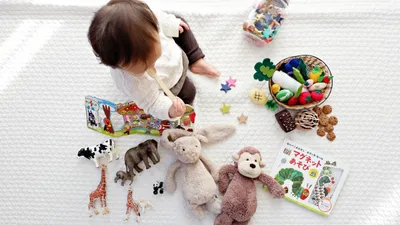
- Miniature objects for naming (small realistic figurines of animals, vehicles, household items)
- Board books with real photographs
- Singing and nursery rhymes (your voice is the best language material)
Montessori Object Matching Cards — Sets of cards with real photographs paired with miniature objects. The child matches the object to its picture, naming each one. This three-period lesson format (this is a dog, show me the dog, what is this?) is the Montessori method for vocabulary building.
Ages 2.5-4: Pre-reading and pre-writing
The Montessori language materials bridge the gap between spoken language and written language through tactile, multi-sensory approaches.
Essential materials:
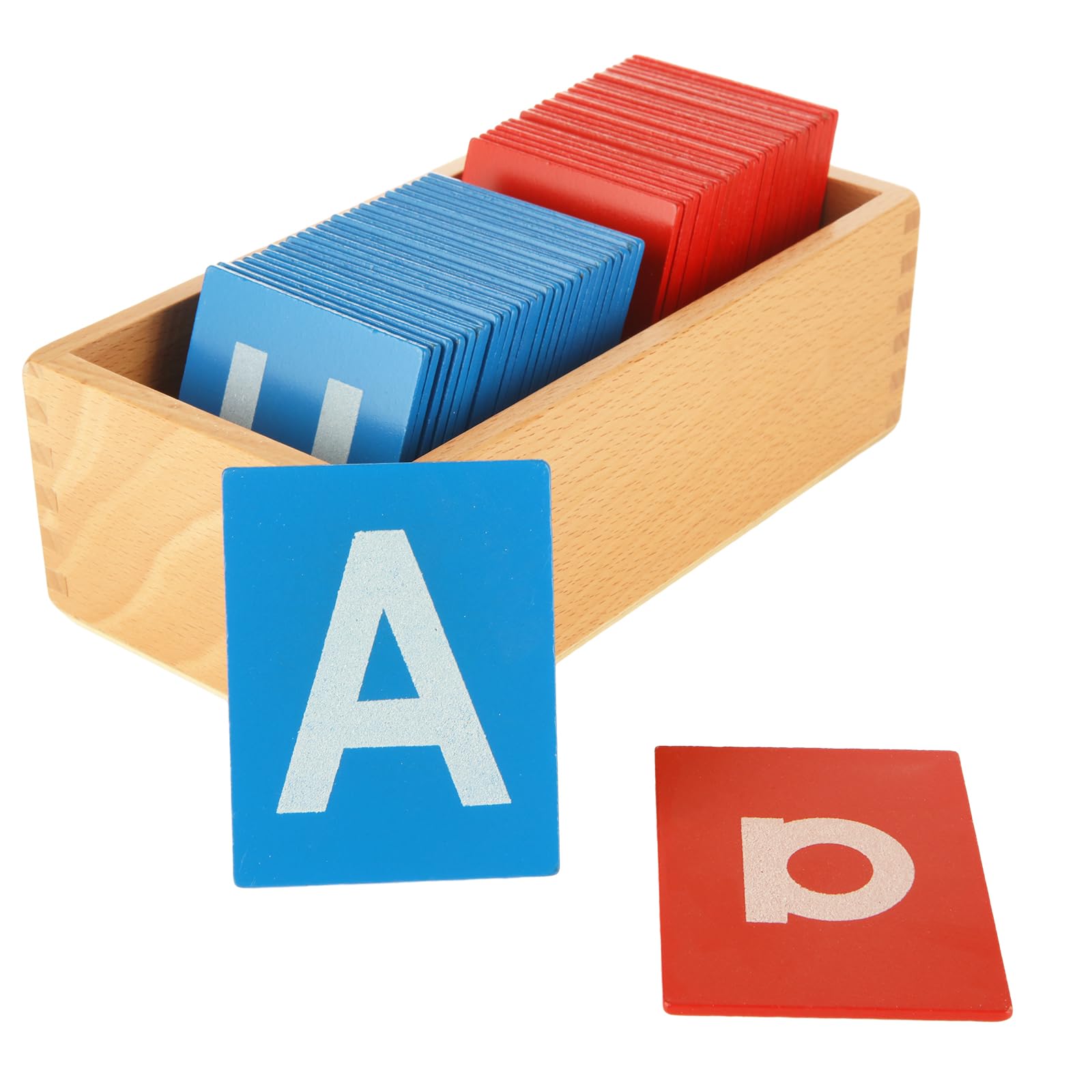
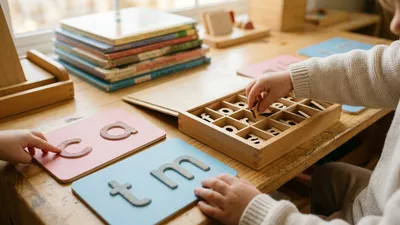
Sandpaper Letters — Letters cut from sandpaper and mounted on wooden boards. The child traces each letter with their fingers while saying the sound (not the letter name). This engages three senses simultaneously: touch (the texture), sight (the shape), and hearing (the sound). The tactile memory of letter shapes transfers directly to writing.
How to present sandpaper letters:
- Start with 3 letters that look and sound different (m, a, t)
- Trace with two fingers while saying the sound: “mmm”
- Use the three-period lesson: “This says mmm. Show me mmm. What does this say?”
- Add 2-3 new letters per week as the child masters previous ones
- Consonants on pink/red boards, vowels on blue boards (colors vary by tradition)
Movable Alphabet — A box of loose letters (typically wooden or plastic) that the child uses to build words. This is where writing emerges before reading: the child knows the sounds of letters from sandpaper work and can now compose words by laying out sounds in sequence. “C-A-T” is built letter by letter, each sound spoken aloud.
For more language materials, see our Montessori language toys guide.
Ages 4-6: Reading and writing fluency
Phonetic Reading Cards — Cards progressing from three-letter phonetic words (cat, dog, run) to blends, digraphs, and eventually sight words. The self-pacing nature means advanced readers move quickly while developing readers spend more time at each level.
Writing materials:
- Metal insets (geometric shapes for tracing that develop pencil control)
- Lined paper with wide spacing
- Colored pencils (not crayons — pencils develop the proper grip)
Mathematics learning toys by age
Ages 2-3: Number awareness
Before formal counting, children need to develop number sense — the intuitive understanding that quantities exist and can be compared.
Essential materials:
Montessori Number Rods — Ten rods graduated in length from 10cm to 100cm, alternating red and blue in 10cm segments. Each rod represents a number: the shortest rod is 1, the longest is 10. The child can SEE and FEEL that 5 is longer than 3. This is quantity made physical.
Counting with real objects: Before any formal material, count everything: steps, crackers, blocks, buttons. The brain builds number sense through countless experiences of matching number words to real quantities.
Ages 3-5: Concrete mathematics
This is where Montessori math materials truly shine. Concepts that are traditionally taught abstractly are made physically tangible.
| Material | Teaches | Concrete Representation |
|---|---|---|
| Number rods + cards | Numbers 1-10 | Length = quantity |
| Spindle box | Zero, fixed quantities | Empty compartment = zero |
| Sandpaper numbers | Number symbols | Tactile number writing |
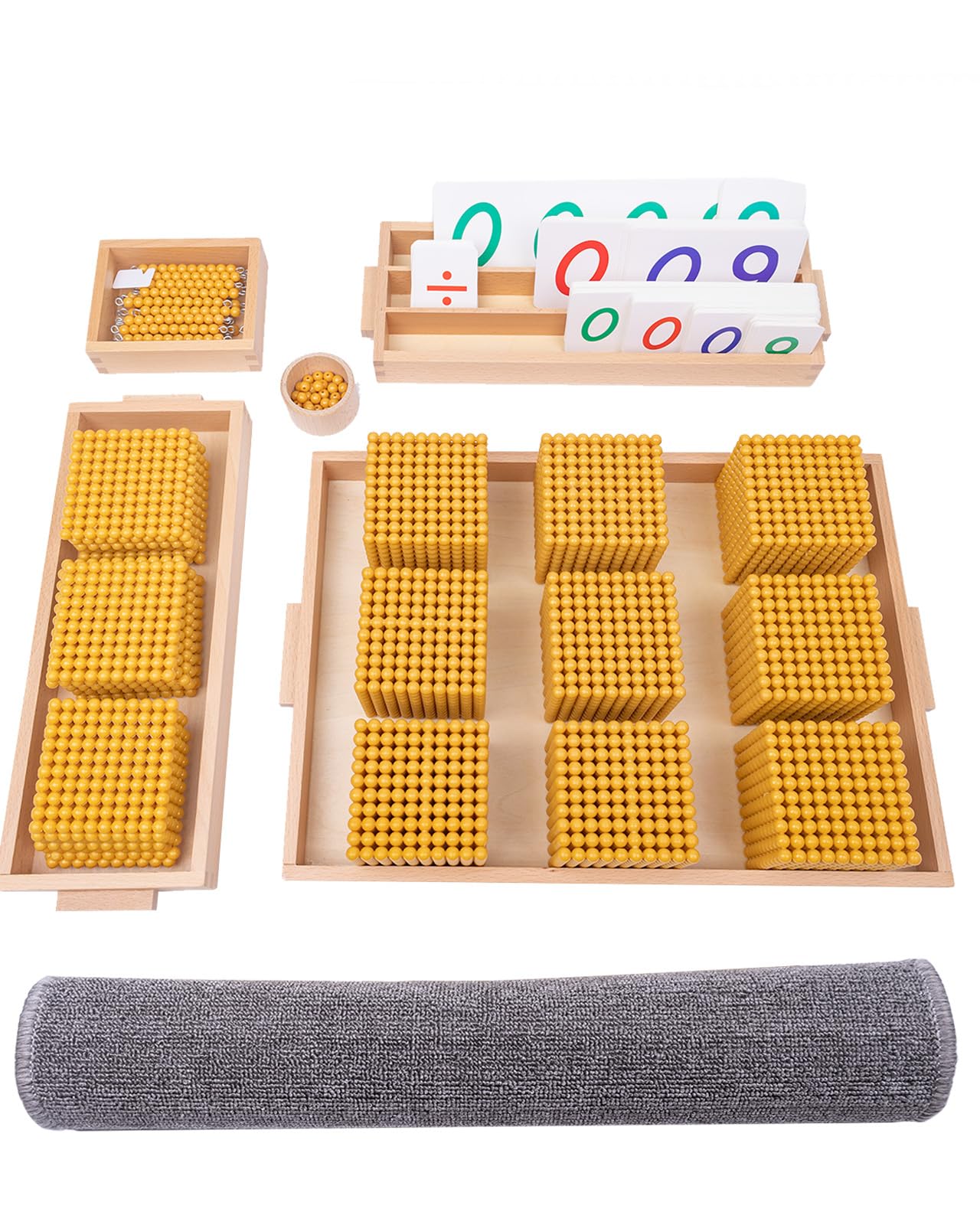
| Golden beads | Decimal system | 1 bead = 1 unit, 10-bar = ten, 100-square = hundred, 1000-cube = thousand |
| Stamp game | Operations (+-x÷) | Colored stamps represent place values |
| Bead stair | Numbers 1-9 | Color-coded bead bars of increasing length |
Montessori Golden Bead Material — The golden bead material is perhaps the most powerful math tool ever designed. A single golden bead represents 1. A bar of 10 beads represents 10. A square of 100 beads represents 100. A cube of 1,000 beads represents 1,000. The child can hold 1,000 in their hands and feel its weight. They can compare the single bead to the cube and physically understand that 1,000 is 1,000 times as much. When they later see “1,000” written on paper, the concept has a concrete referent.
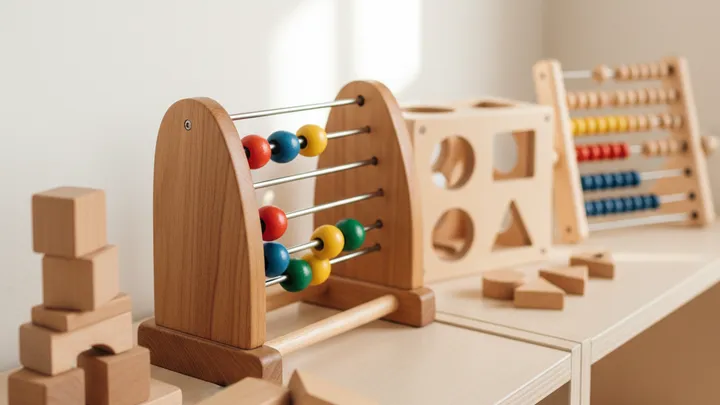
Montessori Bead Stair — Nine bead bars (1-9) in a color-coded system. One red bead is 1. Two green beads is 2. Up to nine gold beads is 9. Used for counting, addition, and building mathematical fluency. The colors create visual anchors that help the child remember number facts.
For a complete math materials guide, see our Montessori math toys article.
Ages 5-6: Abstract transition
Materials at this stage bridge concrete manipulation and abstract notation:
- Stamp game (colored stamps replace beads for operations)
- Small bead frame (abacus-like tool for large number operations)
- Multiplication and division bead boards
- Fraction circles and skittles
Practical life learning toys by age
Practical life materials are often overlooked by parents who associate “learning” with academic skills. But in Montessori education, practical life IS the foundation. It develops concentration, fine motor control, sequencing, and independence — all prerequisites for academic learning.
Ages 1-2: First independence
Essential materials:
- Small pitcher and cups for pouring practice
- Simple dressing frames (large buttons, velcro)
- Child-sized broom and dustpan
- Basket of clothespins for finger strength
Montessori Pouring Set — A small ceramic or glass pitcher and two small cups. The child practices pouring water (or rice, then water) from pitcher to cup. This develops bilateral coordination, pouring control, and concentration — and it directly prepares the child for self-serving at meals.
Parent tip: Use real materials — real glass, real ceramic, real metal. Children handle real items more carefully than plastic because they can break, and the consequence of dropping something is a natural lesson in careful handling. Keep a small sponge nearby for spills.
Ages 2-4: Skill development
Essential materials:
- Dressing frames (buttons, zippers, buckles, laces, snaps)
- Food preparation tools (child-safe knife, cutting board, peeler)
- Cleaning tools (spray bottle, cloth, sponge, brush)
- Sewing materials (large needles, burlap, yarn)
- Spooning and transferring activities
Montessori Dressing Frames Set — Wooden frames with fabric panels that practice specific fastening skills. Each frame isolates one skill: large buttons, small buttons, bow-tying, zipping, snapping, buckling. The child works with each frame until the skill transfers to their own clothing.
Ages 4-6: Real-world competence
At this stage, practical life shifts from exercises to real responsibilities:
- Preparing complete snacks and simple meals independently
- Laundry sorting and folding
- Plant care and gardening
- Table setting and dish washing
- Self-care routines (brushing teeth, combing hair, dressing completely)
For comprehensive practical life ideas, see our practical life activities guide.
Motor development learning toys
Fine motor progression
| Age | Skill Developing | Best Material |
|---|---|---|
| 0-6 mo | Grasp reflex to palmar grasp | Rattles, rings |
| 6-12 mo | Palmar grasp to pincer grasp | Stacking rings, nesting cups |
| 12-18 mo | Pincer grasp refinement | Pegboard, threading beads |
| 18-24 mo | Wrist rotation, release control | Pouring, spooning, turning knobs |
| 2-3 yr | Tripod grasp development | Cylinder blocks, pencil work |
| 3-4 yr | Cutting, drawing, writing prep | Scissors, metal insets, tracing |
| 4-6 yr | Writing and drawing fluency | Sandpaper letters, pencil work |
Stacking Rings Set — The classic stacking toy develops hand-eye coordination, size discrimination, and the precision needed to place a ring onto a post. Choose a wooden set with a straight post (not rocking) for the most challenge.
For detailed fine motor recommendations, see our fine motor toys guide.
Gross motor progression
Gross motor development supports everything from sitting still (core strength) to handwriting (shoulder stability). Key materials include:
- Pikler triangle (climbing, spatial awareness, risk assessment) — see our Pikler triangle guide
- Balance board (vestibular development, core strength)
- Push cart (walking support, bilateral coordination)
- Climbing dome (upper body strength, motor planning)
- Mini trampoline (vestibular input, proprioception, energy regulation)
For more movement ideas, see our climbing toys guide and gross motor toys guide.
Building your Montessori learning toy collection
The budget-conscious buying sequence
You do not need to buy everything at once. Here is the recommended purchase order based on developmental impact per dollar:
Phase 1 — Baby essentials ($30-50):
- High-contrast cards (DIY or $8-12)
- Munari mobile (DIY or $15-25)
- Wooden rattle ($8-12)
- Treasure basket items (free from household)
Phase 2 — Toddler foundations ($50-100):
- Object permanence box ($15-25)
- Stacking rings ($12-18)
- Nesting cups ($8-12)
- Small pitcher and cups for pouring ($10-15)
- First puzzle (single-piece inset) ($8-12)
Phase 3 — Preschool sensorial ($100-150):
- Cylinder Block 1 ($30-40)
- Pink Tower ($25-35)
- Sandpaper letters ($25-35)
- Color sorting materials ($15-25)
Phase 4 — Preschool academics ($100-150):
- Movable alphabet ($25-35)
- Number rods ($25-35)
- Golden bead introduction set ($30-40)
- Dressing frames ($20-30)
Total investment for a comprehensive home collection: $280-450 over 3-4 years. This is less than many parents spend on a single holiday season of conventional toys, and these materials have a useful life of 2-4 years each.
Where to buy
| Source | Quality | Price | Best For |
|---|---|---|---|
| Nienhuis Montessori | Classroom premium | $$$$ | Schools, dedicated families |
| Elite Montessori | Good home use | $$ | Best value for complete sets |
| Adena Montessori | Good home use | $$ | Individual materials |
| Etsy (handmade) | Variable | $$-$$$ | Unique, beautiful pieces |
| Amazon (various) | Variable | $-$$ | Convenience, reviews |
| DIY | Depends on skill | $ | Budget-conscious families |
Storage and display
Montessori materials should be displayed on low, open shelves at the child’s eye and hand level. Each material has its own tray or designated spot. The child can see all available options, choose independently, use the material, and return it to its spot.
Shelf organization principles:
- Left to right, simple to complex (mirrors reading order)
- Each material on its own tray or in its own basket
- Maximum 6-8 materials displayed at once
- Rotate every 1-2 weeks based on observation of the child’s interests
- Keep shelves uncluttered — empty space is part of the organization
The single most important principle
After all the materials, products, techniques, and recommendations in this guide, the most important thing to understand about Montessori learning toys is this: the material is not the teacher. The child is the learner, and the material is the tool. Your role is to observe, present materials at the right time, step back, and let the child do the work.
This requires trust. Trust that your child will choose what they need. Trust that repetition is learning, not boredom. Trust that struggle is growth, not failure. Trust that the quiet, focused concentration of a child working with a simple wooden material is more valuable than any flashy electronic learning toy could ever be.
The materials in this guide have helped children learn for over a century. They work not because they are old or traditional but because they are aligned with how human brains actually develop: through the hands, through the senses, through repeated exploration, and through the profound satisfaction of understanding something new.
For age-specific recommendations, explore our guides for 1 year olds, 2 year olds, 3 year olds, 4 year olds, and 5 year olds.