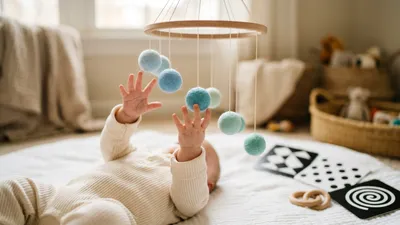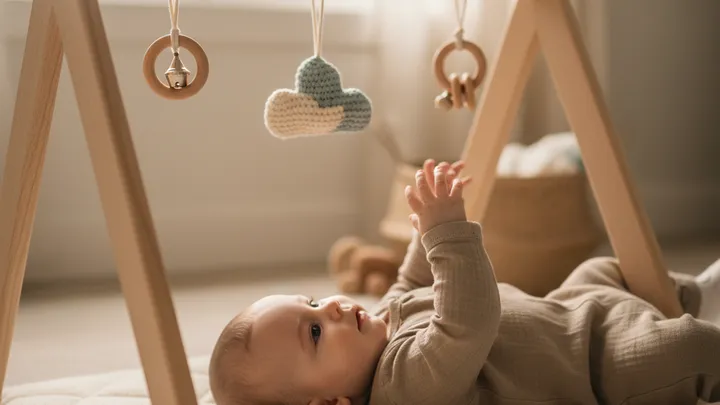
A Montessori play gym uses natural materials, detachable hanging objects, and a simple design that lets the baby focus on one visual or tactile experience at a time. The best options are wooden-arch gyms with interchangeable hanging toys. The Lovevery Play Gym is the gold standard but there are excellent budget alternatives. Avoid plastic gyms with electronic lights and music that overstimulate developing senses.
A play gym is one of those baby items that seems simple — a frame with things hanging from it — but the design choices make a significant difference in how your baby interacts with it and what they learn from that interaction. The difference between a Montessori-aligned play gym and a conventional one is the difference between focused engagement and scattered overstimulation.
Walk into any baby store and you will find play gyms dripping with plastic characters, electronic buttons, flashing lights, and tinny music boxes. They are designed to attract the parent’s eye, not to serve the baby’s brain. A 2-week-old does not need twenty things to look at simultaneously. They need one thing, clearly presented, that their developing visual system can actually focus on.
Maria Montessori understood this: simplify the environment so the child can concentrate. A Montessori play gym applies this principle from the very first weeks of life. This guide covers what makes a play gym Montessori-appropriate, the best options at every price point, how to use one effectively from birth through the first year, and the science behind why it matters.
Why a play gym matters for infant development
A play gym is not just a place to put your baby while you take a breath (though it serves that function too, and that is valid). It is a structured environment that supports several critical developmental processes simultaneously.
Visual development. In the first weeks, babies see about 8-12 inches clearly. A play gym places objects at exactly this distance. As their focus improves, hanging objects provide the visual tracking practice that is a prerequisite for reading years later. Research published in Developmental Science shows that tracking moving objects in the first months strengthens the neural pathways connecting the visual cortex to the frontal lobe.
Reaching and grasping. Around 3-4 months, babies begin reaching intentionally toward objects they can see. A play gym provides perfect targets — objects that move when touched, providing immediate feedback that rewards the effort of reaching. This is cause and effect in its simplest, most powerful form.
Body awareness. When a baby bats at a hanging object and it moves, they learn something profound: I can affect the world around me. This develops agency — the understanding that their body is a tool that produces results. The psychologist Albert Bandura called this self-efficacy, and its foundations are built in these early months.
Tummy time motivation. Many babies resist tummy time because there is nothing interesting to look at. Place them under a play gym on their stomach, and suddenly the hanging objects provide a reason to lift their head, push up on their arms, and reach — all the movements that tummy time is supposed to develop.
What makes a play gym Montessori-aligned
Not every wooden play gym is Montessori-aligned, and not every Montessori play gym must be made of wood. The principles matter more than the material:
Natural materials preferred. Wood, cotton, wool, silk, metal — these provide varied sensory feedback. Wood feels warm and has grain. Metal feels cool and smooth. Cotton absorbs, silk slides. Each material teaches something about the physical world that plastic cannot.
Detachable, interchangeable hangings. This is the most important feature. A conventional play gym has permanently attached toys. A Montessori gym has a simple frame with hooks or loops from which you can hang different objects at different stages. This means the same gym grows with your baby for 12 months instead of becoming boring at 4 months.
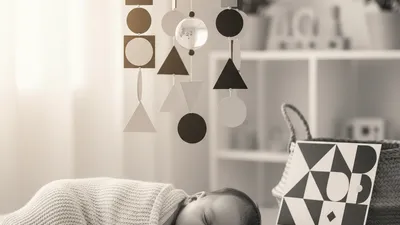
Simplicity. Three hanging objects is better than seven. Each hanging should be visually distinct and isolate one sensory quality. A black and white card isolates contrast. A wooden ring isolates shape and texture. A small bell isolates sound. Together they overwhelm; separately they educate.
No electronics. No batteries, no speakers, no LED lights. The play gym is powered by the baby’s own actions and attention.
Stable, safe frame. The frame must not tip over when a 6 month old pulls hard on a hanging object. Wide-base wooden A-frames and arch designs are the most stable. All finishes must be non-toxic and food-safe because everything enters the mouth eventually.
The best Montessori play gyms compared
Lovevery Play Gym — The gold standard
Lovevery The Play Gym — Designed by child development experts and made from sustainably sourced wood, organic cotton, and safe silicone, the Lovevery Play Gym is the benchmark against which all others are measured. It includes five distinct play zones on the mat, interchangeable high-contrast cards, wooden batting objects, a teething ring, and a play guide with activities for each developmental stage.
What makes it special:
- The mat has five zones: black and white contrast, color, a mirror, a batting area, and a hidden pocket for peek-a-boo
- Includes a card holder for the Montessori mobile progression (Munari-style black and white cards, then color cards)
- The wooden arch is stable and attractive enough to leave in a living room
- Organic cotton mat is machine washable
- Designed for birth through 12 months with changing activities
What could be better:
- At approximately $140, it is the most expensive play gym on the market
- The mat zones are useful but some parents find them busier than a pure Montessori approach would suggest
- The branded accessories create a closed ecosystem — you are buying into their specific hangings
Verdict: If budget allows, this is the most thoughtfully designed play gym available. Read our full Lovevery Play Kits review for more detail on their approach.
Wooden arch play gyms — Best value
Wooden Baby Play Gym with Hanging Toys — Simple wooden arch gyms from various manufacturers offer the core Montessori experience at $40-70. They typically include a wooden or bamboo arch frame with 3-4 hanging toys (wooden rings, silicone shapes, fabric objects).
What to look for in a wooden arch gym:
- Solid hardwood or bamboo construction (avoid thin plywood that wobbles)
- Wide base that resists tipping
- Hooks or loops for easy hanging changes (avoid permanently attached items)
- Non-toxic, food-safe finish (water-based stain or natural oil)
- Included hangings are a bonus but the real value is the frame itself
Top picks in this category:
| Brand | Material | Hangings Included | Stability | Price |
|---|---|---|---|---|
| Little Partners | Hardwood | 3 silicone + wood | Excellent | $65 |
| Finn + Emma | Organic wood | 3 organic knit | Good | $55 |
| Plan Toys | Rubberwood | 3 wooden | Excellent | $70 |
| Generic bamboo arch | Bamboo | 3-4 mixed | Variable | $35-45 |
Foldable play gyms — Best for small spaces
Foldable Wooden Play Gym — If you live in a small apartment or want a gym that stores flat, foldable designs collapse the A-frame when not in use. They sacrifice some stability for portability but work well on a non-slip mat.
DIY play gym — Best for hands-on parents
Building a Montessori play gym is a satisfying weekend project that costs $20-30 in materials:
Materials needed:
- Two wooden dowels, 24 inches long, 1.5 inch diameter (the legs)
- One wooden dowel, 24 inches long, 1 inch diameter (the crossbar)
- Wood screws or strong wood glue
- Sandpaper (150 and 220 grit)
- Food-safe finish (beeswax, mineral oil, or water-based polyurethane)
- Elastic loops or small hooks for hanging items
Assembly:
- Cut leg dowels to create two A-frame sides (or use pre-angled cuts)
- Attach crossbar at the top with screws
- Sand everything smooth — pay special attention to joints and ends
- Apply food-safe finish and let cure completely
- Attach 3-4 elastic loops or screw-in hooks along the crossbar
The advantage of DIY is complete control over height, width, and hangings. You can also make it perfectly match your nursery aesthetic.
How to use a play gym by developmental stage
The real power of a Montessori play gym comes from changing how you use it as your baby grows. This is the rotation principle that makes a single gym last the entire first year.
Newborn to 6 weeks: Visual focus
What to hang: High-contrast black and white geometric shapes. A Munari-style mobile element (black and white geometric shapes with reflective elements) is ideal. Commercial black and white cards in a card holder also work.
Position: Hang items 10-12 inches from the baby’s face. They should be still or moving very gently.
What the baby is doing: Focusing, tracking slowly moving objects, beginning to coordinate eye movements. Their visual system is building the pathways it needs for everything that comes later.
Session length: 5-10 minutes, 2-3 times daily.
6 weeks to 3 months: Color and movement
What to hang: Introduce primary-color objects. The Montessori octahedron mobile (three octahedrons in red, blue, and yellow) is the classic choice. Simple colored wooden shapes work well too.
Position: Hang at 10-14 inches, allowing gentle movement from air currents.
What the baby is doing: Tracking moving objects across their visual field, beginning to swipe at objects (usually missing), expressing interest through kicking and vocalizing.
Session length: 10-15 minutes, multiple times daily.
3 to 5 months: Reaching and batting
What to hang: Objects that move and make gentle sounds when hit. Wooden rings, small bells on short ribbons, fabric knots. The objects should be reachable — hang them so the baby can make contact when reaching upward.
Position: Lower the hangings so the baby can bat at them successfully.
What the baby is doing: Intentional reaching, cause-and-effect learning (I hit this, it moves and makes sound), developing hand-eye coordination, building shoulder and arm strength.
Session length: 15-20 minutes. The baby will often play intensely and then stop abruptly when done.
5 to 8 months: Grasping and pulling
What to hang: Objects the baby can grasp and hold. Wooden rings with a diameter they can close their hand around, fabric ribbons tied in knots, teething rings. Items should hang on elastic so the baby can pull them down and they spring back.
Position: At arm’s length when the baby is reaching upward.
What the baby is doing: Practicing the palmar grasp, transferring objects between hands, pulling objects to their mouth, beginning to understand gravity (pull down, it springs back up).
Session length: 15-25 minutes. At this stage, the play gym competes with crawling for the baby’s attention, which is fine — let them choose.
8 to 12 months: Transition and graduation
Most babies begin losing interest in the play gym around 8-10 months as crawling and pulling to stand become more interesting. This is appropriate and should be honored. You can:
- Use the gym frame as a structure to pull up on (if stable enough)
- Move the gym outdoors for a different sensory environment
- Hang new and more complex objects to renew interest
- Retire the gym gracefully when the baby is clearly done with it
For activities beyond the play gym, explore our guide to Montessori activities for babies.
Play gym versus Montessori mobiles: what is the difference?
Parents often confuse play gyms with mobiles, or wonder if they need both. The answer depends on the purpose:
Montessori mobiles are visual materials designed to be observed, not touched. They hang above the crib at a distance the baby cannot reach. The progression (Munari, Octahedron, Gobbi, Dancer) develops visual focus and tracking. They are for calm, focused observation.
Play gyms are interaction materials designed to be reached for, batted, grasped, and pulled. They sit on the floor at arm’s reach. They develop motor skills, cause-and-effect understanding, and hand-eye coordination. They are for active engagement.
Do you need both? The ideal is yes — a mobile over the crib for quiet focus times, and a play gym on the floor for active play times. But if you must choose one, the play gym is more versatile because you can hang mobile-style objects from it for visual observation AND provide reaching objects for active play.
Common play gym mistakes to avoid
Hanging too many objects. Three items is enough for the first several months. Add a fourth around 4-5 months if your baby is tracking and reaching well. More than four creates visual clutter that fragments attention.
Not changing the hangings. A play gym with the same three objects from birth to 8 months is a play gym that stopped being educational at 3 months. Change the hangings every 2-3 weeks to match what your baby is developmentally working on.
Placing the gym on an unstable surface. The gym should be on a firm, flat floor with a mat or blanket beneath it. Soft mattresses, couches, and plush carpeting make the frame unstable and the baby’s surface too cushiony for effective tummy time.
Using it as a containment device. A play gym is not a baby cage. Do not leave the baby under it for extended periods while you are in another room. It is a play station for supervised, engaged floor time.
Choosing electronic over natural. The Fisher-Price and similar electronic gyms with light shows and music are designed to entertain the parent, not educate the baby. The research consistently shows that simpler materials produce deeper engagement and better developmental outcomes.
What to look for when shopping: the checklist
Use this checklist when evaluating any play gym:
- Made from natural materials (wood, cotton, silicone) or at least BPA-free
- Hanging items are detachable and interchangeable
- Frame is stable and does not tip when pulled
- Finish is non-toxic and food-safe
- No electronic components (lights, sounds, music)
- Hanging height is adjustable or easy to modify
- Frame accommodates both back-lying and tummy time positions
- Price is justified by material quality and design
If a gym checks all eight boxes, it is a good Montessori-aligned option regardless of brand or price point. The frame is just a frame — the magic is in how you use it and what you hang from it. Rotate the hangings, observe your baby’s changing interests, and trust that the simple act of reaching for a wooden ring is building the neural architecture that supports everything from writing to sports to playing a musical instrument.
The best play gym is the one you use consistently, change regularly, and eventually retire with a smile because your baby has outgrown it and moved on to bigger explorations. That is exactly how development is supposed to work.