Newborns need very few toys, but the right ones make a significant impact. The Montessori approach for 0-3 months centers on four elements: high-contrast black and white visual cards, the Munari mobile (and subsequent mobile progression), simple wooden rattles for auditory development, and gentle tactile materials like fabric squares and wooden rings. Skip electronic toys entirely — your voice, face, and touch remain the most important sensory inputs for a newborn.
Your newborn arrived, and the gifts have started arriving too. Stuffed bears, plastic rattles that play electronic music, light-up mobiles that project patterns on the ceiling, plush toys in every color. All well-intentioned. Almost none of it useful for what your baby’s brain actually needs right now.
Here is what a newborn can see: not much. Their focus distance is approximately 8-12 inches — about the distance from the crook of your arm to your face during feeding. Everything beyond that distance is a blur. They see high contrast (black and white, light and dark) clearly, but colors are muted and indistinct. That brightly colored elephant mobile hanging 3 feet above the crib? Your baby literally cannot see it with any clarity.
Here is what a newborn needs to see: your face. High-contrast patterns. Simple shapes. Nothing more for the first weeks of life.
The Montessori approach to newborn toys reflects this reality. It is radically simple — a handful of carefully designed materials that match the actual sensory and developmental capabilities of a 0-3 month old. No batteries. No electronics. No overstimulation. Just the right input at the right time.
This guide covers everything you need for the first three months, including the famous Montessori mobile progression, the best first sensory materials, and the science behind why simple outperforms complex at this age. For the continuation from 3-12 months, see our guide to the best Montessori toys for babies.
What a newborn brain is actually doing
Understanding the neuroscience helps explain why specific materials matter more than quantity.
In the first three months, the brain is focused on three primary tasks:
1. Building the visual system. At birth, the visual cortex is the least developed sensory region. It develops through use — by receiving visual input and processing it. High-contrast patterns provide the strongest visual signals, which is why they are developmentally ideal. The brain prioritizes building connections for processing contrast, edges, and basic shapes before tackling color, depth, and motion.
2. Calibrating the auditory system. Hearing is relatively mature at birth (the auditory system develops in utero), but the brain must learn to localize sound (where is it coming from?), discriminate between sounds (is that Mom or someone else?), and connect sounds to their sources (that sound happens when this object moves).
3. Integrating sensory information. The newborn brain is learning to combine inputs from different senses: the face they see is the voice they hear is the skin they feel. This cross-modal integration is the foundation for all later learning, and it develops through consistent, multi-sensory experiences — primarily through interaction with caregivers.
The Montessori mobile progression: birth to 14 weeks
The Montessori mobile sequence is perhaps the most elegant educational design ever created for newborns. Four mobiles, presented in order, each matching the specific visual ability that is developing at that stage. When you understand why each mobile exists, you will never look at a baby store mobile the same way again.
Mobile 1: The Munari Mobile (birth to 6 weeks)
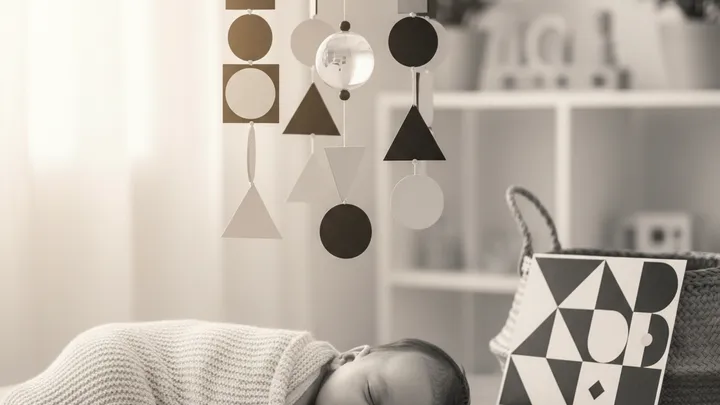
What it is: Black and white geometric shapes (circles, squares, rectangles) arranged on horizontal dowels with a single clear glass sphere that catches and reflects light. The shapes are flat, two-dimensional, and arranged to balance each other.
Why it works: In the first weeks, a newborn’s visual system can only reliably detect high contrast — the boundary between black and white. The Munari mobile provides the strongest possible visual signal in the exact frequency range the developing visual cortex can process. The glass sphere adds a point of reflected light that draws and holds the eye.
How to use it: Hang 10-14 inches above the baby’s eye level, over the crib or a play mat. The mobile should move gently with air currents — the slow movement provides visual tracking practice. The baby will stare at it with intense focus, sometimes for 10 minutes or more. This focused staring is the visual system under construction.
Montessori Munari Mobile — Purchase a quality Munari mobile with balanced geometric shapes and a glass sphere. The shapes should be matte black and white (not glossy, which creates glare).
DIY option: Print black and white geometric shapes on card stock, cut them out, and hang them from wooden dowels with fishing line. Add a clear glass Christmas ornament for the sphere element. Total cost: under $5. Detailed instructions are available in many Montessori parenting books.
Mobile 2: The Octahedron Mobile (6 to 8 weeks)
What it is: Three three-dimensional octahedrons (eight-sided shapes) in the primary colors: red, blue, and yellow. Each shape is made from folded glossy paper or cardstock that reflects light from its facets.
Why it works: Around 6 weeks, the baby’s color vision is beginning to develop. They can now detect highly saturated primary colors, though subtle shades remain invisible. The three-dimensional octahedrons introduce color AND depth — the facets catch light differently as the mobile rotates, creating a shifting visual experience that challenges the developing visual system.
How to use it: Replace the Munari mobile when the baby seems less engaged with it (typically around 5-6 weeks). Hang at the same distance. The shiny, reflective facets will immediately capture the baby’s attention in a new way.
Montessori Octahedron Mobile — Look for sets made from high-quality glossy cardstock in true primary colors.
DIY option: Print octahedron templates on glossy cardstock in red, blue, and yellow. Fold and glue. Hang from a dowel with thread. This is a satisfying craft project that takes about 30 minutes.
Mobile 3: The Gobbi Mobile (8 to 10 weeks)
What it is: Five spheres wrapped in embroidery thread, all in the same color but in a gradient from light to dark. They hang at graduated heights — the darkest at the highest point, the lightest at the lowest.
Why it works: The Gobbi mobile introduces color gradation — the ability to perceive subtle differences within a single color family. This is a significant cognitive leap from the binary contrast of the Munari and the primary color distinction of the Octahedron. The graduated heights add depth perception practice.
How to use it: Replace the Octahedron when interest wanes (typically around 8 weeks). The baby will study the gradient intently, their eyes moving from sphere to sphere, processing the subtle differences.
Montessori Gobbi Mobile — The Gobbi requires carefully graded thread wrapping. Quality matters here — the gradation should be smooth and consistent.
DIY option: Wrap five small styrofoam balls with embroidery thread in five shades of one color (available at craft stores). Hang on a dowel at graduated heights. Time-intensive but beautiful.
Mobile 4: The Dancer Mobile (10 to 14 weeks)
What it is: Lightweight figures cut from holographic or iridescent paper, shaped like dancing human figures with flowing limbs. The figures spin and flutter with the slightest air current.
Why it works: By 10 weeks, the visual system has developed enough to track rapid, unpredictable movement. The Dancer mobile introduces complex motion — spinning, fluttering, changing direction — that challenges the visual tracking system. The holographic paper creates shifting colors and light reflections that engage the now-maturing color vision.
How to use it: This is the final mobile in the progression. It bridges the visual focus period (0-3 months) and the reaching period (3-5 months). As the baby watches the dancers move, they may begin making swiping motions toward them — the first precursors of intentional reaching.
Montessori Dancer Mobile — Holographic paper dancers that move freely in air currents.
DIY option: Cut dancer shapes from holographic gift wrap or scrapbook paper. Punch a hole in the top of each and hang from a dowel with thread. The paper naturally curls and spins.
High-contrast cards and images
High-contrast cards are the simplest and most effective visual stimulus for newborns. They are also the easiest to make, the cheapest to buy, and the most versatile to use.
Why black and white cards work
The newborn visual cortex responds most strongly to edges — the boundary where black meets white. This is not a preference; it is a neurological fact. Brain imaging studies show that the visual cortex of newborns produces its strongest signal in response to high-contrast patterns, and that this signal drives the synaptic connections that build visual acuity.
How to use them
During feeding: Prop a card on the arm of the nursing chair or next to the bottle. At the 8-12 inch focal distance, the patterns will be clearly visible and provide visual stimulation during feeding sessions.
During tummy time: Place a card in front of the baby during tummy time. The interesting pattern motivates head lifting — the primary physical goal of tummy time.
On the wall: Tape a card to the wall at crib height where the baby typically looks (usually to one side rather than straight up).
Cycling through: Start with simple patterns (a circle, a bullseye, a checkerboard). Progress to more complex patterns (concentric squares, spirals, faces) as the baby matures. Change the cards every 3-5 days.
High-Contrast Baby Cards Set — A set of sturdy, high-quality black and white cards with a range of patterns. Look for sets that include simple patterns for the earliest weeks and progressively complex patterns for the following months.
DIY option: Print black and white geometric patterns on cardstock. Laminate for durability. Free printable patterns are widely available online. A set of 10-15 cards takes about 20 minutes to make and costs under $3.
First touch: sensory materials for newborns
Touch is the most developed sense at birth, and skin-to-skin contact with caregivers is the most important sensory experience. But there are simple materials that supplement this primary tactile input.
Fabric squares
What: Small squares (4x4 inches) of different fabrics: silk, cotton, wool, velvet, muslin, linen.
How to use: During alert periods, gently touch a fabric square to the baby’s palm, cheek, or foot. Name the texture: “This is silk. It is smooth.” The baby’s grasp reflex will cause them to hold the fabric briefly.
Why it matters: Each fabric has a different texture, weight, and temperature. The baby’s tactile system begins building a library of textures that it will reference for the rest of their life.
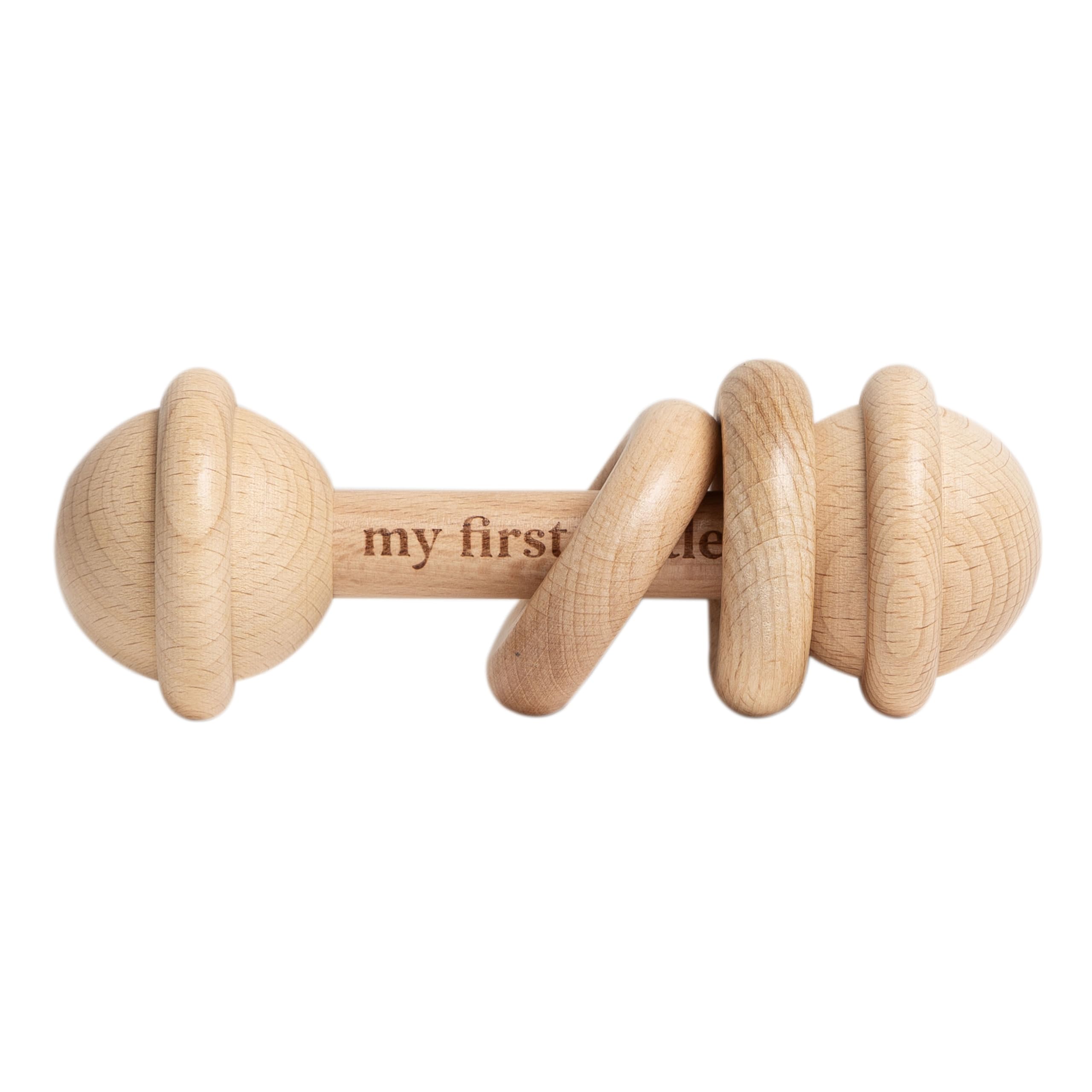
Wooden ring or wooden rattle
A smooth, lightweight wooden ring or rattle serves two purposes: it is one of the first objects the baby can grasp (using the reflex grasp initially, then the intentional grasp around 3-4 months), and it provides a different sensory experience than fabric — hard, smooth, slightly warm, with a distinct weight.
Wooden Baby Rattle — Choose a rattle made from untreated or food-safe finished hardwood. It should be light enough for a newborn to hold when placed in their grasp and smooth enough to safely mouth. Avoid painted rattles in the first months — natural wood is ideal.
Silver or metal rattle
A traditional silver or metal rattle provides a completely different tactile experience: cool to the touch, smooth, hard, and heavier than wood. The sound it produces is also sharper and more resonant than a wooden rattle. The temperature contrast between wood and metal is one of the first tactile discriminations the baby can make.
Auditory materials for the first three months
Your voice
This needs to be stated clearly: your voice is the most important auditory stimulus your newborn will ever receive. It is familiar from the womb, it carries emotional information, and it activates social brain regions that no recorded sound can reach.
Talk to your baby. Narrate what you are doing: “I am changing your diaper. Here is the warm cloth. Now the clean diaper.” This is not babytalk for entertainment — it is the raw material from which language will be constructed over the next two years.
Sing to your baby. Singing combines rhythm, melody, pitch variation, and emotional connection. Research from the University of Montreal shows that singing reduces cortisol levels in infants more effectively than speaking in infant-directed speech.
Simple rattles and bells
A gentle wooden rattle shaken near one ear, then the other, trains sound localization — the brain’s ability to determine where a sound originates. This is a foundational auditory processing skill that supports later abilities like following conversation in a noisy room.
Sound localization game: With the baby lying on their back, gently shake a rattle to one side, about 12 inches from the ear. Watch for the baby to turn toward the sound. Then shake it on the other side. This simple exercise builds the neural pathways connecting the auditory cortex to the motor cortex.
Environmental sounds
A quiet house is not an ideal auditory environment for a newborn. Normal household sounds — cooking, conversation, running water, a washing machine, birds outside — provide the acoustic variety that the auditory system needs. The brain learns to filter important sounds from background noise, and it cannot learn this in silence.
The exception is during sleep. A consistent, low-level white noise during sleep is the one situation where a controlled auditory environment helps — it masks disruptive sudden sounds and supports longer sleep cycles.
Setting up the newborn environment
The Montessori prepared environment for a newborn is strikingly minimal:
Sleep space: A firm crib or bassinet with a fitted sheet. Nothing else — no bumpers, no stuffed animals, no loose blankets (following AAP safe sleep guidelines). The Munari mobile hangs above, within visual range but out of reach.
Awake space: A firm mat or blanket on the floor. A mirror mounted at floor level (baby-safe acrylic). One high-contrast card propped up nearby. One rattle available for the caregiver to use.
That is it. A newborn does not need a room full of toys. They need a calm, safe space with a few carefully chosen visual and auditory inputs and, most importantly, the constant presence of responsive caregivers.
The floor bed concept
In Montessori infant environments, a floor bed (a mattress on the floor instead of a crib) is sometimes used after the first few months. The rationale is that it allows the baby freedom of movement and, later, the ability to get in and out of bed independently. However, the AAP recommends a firm crib or bassinet for safe sleep in the early months. The floor bed is more relevant from around 6-8 months onward. Always prioritize safe sleep guidelines.
Week-by-week progression for the first 12 weeks
This timeline is approximate — every baby develops at their own pace. Use it as a guide, not a schedule.
Weeks 1-2: Munari mobile above the crib. High-contrast cards during feeding and tummy time. Skin-to-skin contact. Gentle voice and singing. The baby spends most of the time sleeping.
Weeks 3-4: Continue Munari mobile. The baby’s awake periods lengthen to 20-40 minutes. Begin offering fabric squares during alert periods. Introduce sound localization games with a gentle rattle.
Weeks 5-6: The baby may show less interest in the Munari — they have absorbed what it teaches. Transition to the Octahedron mobile. Begin very brief tummy time on a firm surface (1-3 minutes) with a high-contrast card for motivation.
Weeks 7-8: Octahedron mobile in use. The baby can now track moving objects with their eyes. Slowly move a high-contrast card from side to side in front of them to practice tracking. Increase tummy time duration as tolerated.
Weeks 9-10: Transition to the Gobbi mobile. The baby is beginning to swipe at objects — not reaching intentionally, but making arm movements in the direction of interesting things. Place a lightweight rattle in their hand to feel the grasp reflex engage.
Weeks 11-12: Gobbi mobile continues. Introduce the Dancer mobile if the baby seems ready for more complex visual input. Social smiling is established — your face is now the most exciting “toy.” Mirror time on the floor becomes especially engaging.
Common mistakes in the newborn period
Overstimulation. The most common mistake. A newborn’s nervous system has a very low threshold for input. Signs of overstimulation: turning the head away, arching the back, hiccupping, yawning, sneezing in clusters, skin color changes, falling asleep abruptly. When you see these signs, stop all stimulation and provide calm, quiet holding.
Too many toys. Three items are enough for the first month: a mobile, high-contrast cards, and your voice. Adding more creates visual and cognitive clutter that the newborn cannot process.
Expecting engagement. Newborns spend 16-17 hours a day sleeping. Their awake periods are brief and sometimes unreliable. Do not expect your baby to lie awake staring at the Munari mobile for an hour. Five minutes of focused visual engagement is a significant event.
Comparing to milestones. “My friend’s baby was tracking objects at 3 weeks and mine is not.” The range of normal development is wide. If you have concerns about your baby’s vision, hearing, or responsiveness, discuss them with your pediatrician.
Electronic noise machines. A white noise machine for sleep is fine and supported by research. A crib mobile that plays electronic music, projects light shows, and spins mechanically is overstimulating and unnecessary. The Montessori mobile is moved by air, not batteries, which creates gentle, unpredictable motion that develops visual tracking more effectively than mechanical rotation.
The role of human connection
This guide has covered materials and tools, but the most important thing in a newborn’s environment is not a thing at all. It is you.
Your face is the most visually interesting object in your baby’s world. Your voice is the most important sound. Your touch is the most significant tactile experience. Your smell is the most comforting olfactory input. No toy, no mobile, no card, and no product can replace the responsive human connection that drives development in the first months of life.
The Montessori materials described here are supplements to, not substitutes for, attentive caregiving. Use them during the alert periods when your baby is awake and interested. Put them away when your baby needs to be held, fed, or soothed. And trust that the simple act of being present, responsive, and loving is doing more for your baby’s development than any material ever could.
For the next stage of development, explore our guides to Montessori activities for babies and Montessori toys for 6 month olds.